Famous for its highly pungent odor, which has been compared to the smell of rotting meat, the Amorphopallus Titanum, or corpse flower, has a highly unpredictable bloom cycle. Native to Sumatra in Indonesia, a specimen of the flower first bloomed in the Western Hemisphere at the New York Botanical Garden in 1937. A second specimen bloomed at the site in 1939.
The flower, which uses its stench to attract pollinators that feed on dead animals, has been carefully nurtured by Botanical Garden staff for almost a decade.
Horticulturalists noticed that the flower bud had formed July 15. On July 18 the flower was moved from the Botanical Garden's behind-the-scenes Nolen Greenhouses for Living Collections to the Enid A. Haupt Conservatory, where it is now on display in the Palms of the World Gallery.
One of the largest flowers in the world, corpse flowers can grow to 12 feet in their natural habitat and 8 feet in cultivation. The Botanical Garden notes that, although the enormous plant resembles one giant flower, it comprises a fleshy central spike called a spadix that holds two rings of male and female flowers, wrapped by a frilly spathe - a modified leaf that looks like a petal.
"During bloom, the spadix self-heats to approximately human body temperature, which helps disseminate odor particles," explained the Botanical Garden, in a statement. "The spathe unfurls during the course of about 36 hours (full bloom) before withering and dying back."
The Botanical Garden is livestreaming the flower on a Corpse Flower Cam.
Plant lovers in the Windy City enjoyed Sprinkler System the rare phenomenon of a corpse flower in bloom when one of the Chicago Botanic Garden's eight corpse flowers, dubbed Alice, began blooming, much to the surprise of horticulturalists.
Republicans will command the House for two more years as Donald Trump's astounding White House triumph helped them keep their record-sized majority nearly intact. "He just earned a mandate," said House Speaker Paul Ryan, who now faces working with a president with whom he had a turbulent relationship during the campaign.
Democrats had envisioned that voters repulsed by Trump comments about women and Hispanics could provide potentially big Election Day gains in suburban and ethnically diverse areas. Instead, the Democrats suffered a dispiriting day with just modest pickups, a maximum of nine, as the GOP swept to control of both ends of Pennsylvania Avenue.
That was well below the 30 seats Democrats needed to capture House control. Republicans currently hold a 247-188 majority, including three vacant seats, the most the GOP has had since their 270 in 1931.
"He turned politics on its head," Ryan, R-Wis., told reporters gathered Wednesday in his hometown of Janesvill e, Wisconsin. Ryan credited the president-elect with helping carry Republicans into Congress and promised to work "hand-in-hand" with him on a GOP agenda.
By Wednesday, Republicans had at least 238 seats - guaranteeing an extension of their six-year run of House control - and just six of their incumbents had lost. The GOP retained seats in Minnesota, New York, Michigan, Pennsylvania, Iowa and Wisconsin that Democrats had coveted.
House Minority Leader Nancy Pelosi, D-Calif., said the two parties "have a responsibility to come together and find common ground." In a written statement, she suggested cooperating with Trump on infrastructure projects and said she will "pray for his success."
It was initially unclear what impact the marginally smaller size of the GOP majority would have on Ryan, who'd angered some Republicans by refusing to campaign for Trump.
While one member of the hard-right House Freedom Caucus was defeated, several newly elected Republican s could bolster it. That would increase conservatives' leverage to demand their way on issues like curbing spending and government regulations.
In Florida, freshman GOP Rep. Carlos Curbelo won a race that underscored the limits of Trump's damage to Republicans. With around 7 in 10 of the Miami-area district's voters Hispanic, Democrats targeted it and the race became one of the country's most expensive with an $18 million price tag. But Curbelo distanced himself from his own party's nominee and prevailed.
Virginia freshman Rep. Barbara Comstock kept her seat in the well-heeled Washington, D.C., suburbs despite Democrats' attempts to lash her to Trump.
Democrats defeated two Florida GOP incumbents, but that seemed due to local circumstances.
Rep. John Mica, 73, a 12-term veteran from the Orlando area, was criticized by GOP strategists for a lackluster campaign and lost to Democrat Stephanie Murphy, a political neophyte. Democrat Charlie Crist, once the sta te's Republican governor, defeated Rep. David Jolly in a St. Petersburg district redrawn to favor Democrats.
Democrats also beat GOP Reps. Scott Garrett, a Freedom Caucus member from New Jersey's New York City suburbs; moderate Bob Dold from outside Chicago; Cresent Hardy of Nevada and New Hampshire's Frank Guinta.
Both parties' candidates and outside groups spent nearly $1.1 billion combined on House campaigns, shy of the $1.2 billion record in 2012, according to the Center for Responsive Politics, a nonpartisan research group. Republicans had only a slight financial edge.
Even with the Ryan-led House GOP's current formidable advantage, work stalled this year on spending bills after hitting objections from conservatives.
Moving into 2017, Congress faces a fresh round of budget legislation plus the need to renew the government's borrowing authority or face an economy-jarring federal default. Those are never easy to pass.
Ryan, 46, has said he wants to be speaker in the new Congress and has expressed confidence in doing so. But he is not immune to ire from the Freedom Caucus, which chased former Speaker John Boehner from Congress last year, and other Republicans upset over his frigid treatment of Trump.
Just a handful of disgruntled conservatives could possibly block Ryan from the 218 votes he'd need to retain his post. That would be an embarrassing setback for the GOP's 2012 vice presidential candidate, who may harbor White House aspirations.
9:10 p.m.ET Winners of competitive House races:
Arizona 1
Arizona 2
California 7
California 10
California 21
California 24
California 25
Colorado 3
Colorado 6
Florida 2 - Neal Dunn (R)
Florida 7
Florida 10 - Val Demings (D)
Florida 13 - Charlie Crist (D)
Florida 18 - Brian Mast (R)
Florida 26
Illinois 10
Indiana 9
Iowa 1
Iowa 3
Kansas 3
Maine 2
Michigan 1
Minnesota 2
Minnesota 3
Minnesota 7
Minnesota 8
Nebraska 2
Nebraska 3
Nevada 4
New Hampshire 1
New Jersey 5
New York 1
New York 21
New York 22
New York 23
New York 24
New York 25
Pennsylvania 8
Pennsylvania 16
Texas 23
Utah 4
Virginia 4
Virginia 5
5:11 p.m. ETHouse Democratic Leader Pelosi said at remarks at the Democratic National Committee that FBI Director Comey became "the leading Republican operative in the country" after sending his initial letter to Committee chairs.
She and DCCC Chair Ben Ray Lujan didn't sound optimistic about picking up a large number of House seats, much less retaking the House. She said they don't intend to lose a single incumbent seat.
-- CBS News' Walt Cronkite.
12:07 p.m. ET Paul Ryan is confident he'll remain speaker of the House next year.
Once Congress returns to Washington next week, House Republicans are slated to hold internal leadership elections -- but Speaker Paul Ryan seems confident his spot as the top House member is secure.
Ryan told a group of reporters Monday in Wisconsin that he is "not worried" about any change in his position.
"I feel very good where I am," Ryan said outside of a local Republican party office, according to Politico. "I've gotten such a great outpouring of support from members. They know I took the job as a sense of duty, that duty is not done, and I plan on continuing doing that duty."
On a Democratic conference call Monday reported by Politico, Democratic leaders blamed FBI Director James Comey for hurting their chances to take back the House.
"We would be in a better place [without the letter] and in the manner he did it," Pelosi reportedly said on the call. "It was out of line, but it helped us in one respect: it brought in small donors. The fact is we had a momentum going with Hillary's campaign."
She noted that in the closing days of the election that Republicans were "coming home anyway, but a couple of points nationwide has an impact on our races." Politico reported that House Democratic aides estimated that Democrats could, as a result of Comey's letter, lose up to 12 seats they'd hoped to pick up.
-- CBS News' Reena Flores
11:40 a.m. ETCBS News is monitoring 47 competitive House races. Bolded names are incumbents.
The suburban lawn is extraordinarily expensive, wasteful, and bad for the environment. So why are Americans obsessed with it?
Meadow lawn, Stony Point House, Charlottesville, VA. Hays+Ewing Design Studio (architecture) with Siteworks (landscape). Photograph by Prakash Patel.
Because environmental challenges are so complicated, potential solutions are rarely as simple as they seem.
For example, the market for electric vehicles (EVs) is growing rapidly, outpacing hybrids, although the supply is nowhere near the million EVs President Obama called for in his 2011 State of the Union Address (which might be why he didn't mention the topic this year). Fewer cars running on fossil fuels are a good thing, right? Actually, a new U niversity of Minnesota report finds that EVs can be worse for the environment than gas cars, depending on https://www.toro.com/en/irrigation where they get their electricity. If the utility grid that charges them is powered by coal, EVs can produce nearly four times more deaths from air pollution. Because coal is the single largest source of grid energy in the US (nearly 40 percent), alternative cars could be exacerbating an already enormous problem.
Similarly, conventional wisdom suggests that more plants are always beneficial to the environment, since they produce oxygen and store carbon. But a new study just published in the Journal of Environmental Management shows that closely cropped lawns--the mainstay of suburbia--actually can produce more greenhouse gases than they absorb. The mowers, fertilizers, water, and other resources required to maintain the clean look of a hectare of grass can result in the equivalent emission s of an airplane flying more than halfway around the world. This confirms earlier research estimating that the emissions from lawn maintenance can be four times greater than the amount of carbon stored.
The total area of American lawns is approximately 50 thousand square miles, about the size of New York State. To keep it well watered takes about 200 gallons per person per day, and nearly a third of all residential water use goes toward landscaping, according to the EPA. All that watering, weeding, mowing, and fertilizing is enormously expensive: Americans reportedly spend $40 billion and 3 billion person-hours on lawn care every year. Why? The landscape equivalent of a crew cut, a grass lawn isn't that attractive; in fact, "lawn" stems from an Old French word originally meaning "barren land." So what accounts for our costly, wasteful obsession?
Like the McMansion, which vaguely echoes European manors, the lawn is a status symbol, meant to evoke aristocratic preceden t. Prior to mowing machines and mechanical watering, finely manicured lawns were expensive and labor intensive, the trappings of wealth. They became popular in northern Europe after the Middle Ages, especially in France during the 18th Century, and the gardens at Versailles introduced the thin swath of grass called tapis vert, "green carpet." The effect was intended to be unnatural, an abstraction that seemed to float above the ground plane.
Millions of Americans invest incredible amounts of time and money to conjure up the ghost of Louis XIV.
What are the alternatives? For one, we could replace ornamental grass with edible plants. In Cities and Natural Process (2004), Michael Hough calculates that a typical lawn needs three times more energy (and associated costs) than an alfalfa patch of the same size. In fact, the rate of energy to maintain a given area of residential lawn significantly exceeds the rate for commercial cornfields in the equivalent amount of soil. G arden lawns could become inevitable. Columbia University biologist Dickson Despommier estimates that to feed the expected population in 2050, we'll need about 2.1 billion acres of additional land--roughly the size of Brazil. Yet, today, more than 80 percent of arable land is already in use. If current farming practices continue, in a few decades there simply won't be enough land to feed everyone. We may be forced to begin growing corn in our front yards. For now, the benefits are clear: locally grown produce tastes fresher and saves huge amounts of energy, emissions, waste, transportation, and infrastructure maintenance.
If you don't want to eat your yard, you can just let it return to native meadow. Middlebury College has reduced the area of its regularly mown lawns by 20 acres (26% of the total), letting those spaces become wildflower meadows instead. The plan has cut emissions and costs, including 670 gallons of gas and 1,000 hours of annual labor, and significantly expanded the natural habitat and beauty on the campus. Native meadows, which have deeper roots, also are more drought resistant and produce less pollen than turf grass lawns. Yet, many residential communities not only discourage wild yards through peer pressure--they actually ban them. In Oak Park, Michigan, for example, it's a criminal misdemeanor not to cut your lawn regularly. They've outlawed the little house on the prairie.
Rich with native grasses, herbs, and shrubs, prairies are amazingly fertile and resilient, surviving long droughts a nd torrential rains and protecting soils from erosion. Once they covered the entire MidWest, from Montana to Michigan, all the way down into Texas. Today, only one percent of tallgrass prairie remains. Imagine if all 50 thousand square miles of residential lawns were converted to native meadows and prairie land, springing to life with edible plants that thrive in the local climate with little need for care. In addition to saving an astounding amount of energy, water, labor, and money, we could help resurrect the native state of the continent--right in our front yards.
Architect Lance Hosey is Chief Sustainability Officer with the global design leader RTKL. His latest book, The Shape of Green: Aesthetics, Ecology, and Design (2012), has been Amazon's #1 bestseller for sustainable design.
Rachio, a Denver-based start-up, has been selling a "smart sprinkler" for the last year. The device takes the place of a traditional control box on an automated home sprinkler system. It hooks the system up to the Internet -- meaning that you can https://www.rodalesorganiclife.com/ control it from a smartphone.
It also means the sprinkler system can now check the weather. If it's going to rain or has rained recently, the system holds off on watering. It also automatically adjusts the watering times for each season. And it waters intermittently to allow for maximum absorption -- which also encourages the grass to grow deeper roots and become more drought-resistant. These things alone can cut lawn water use by 30%, according to the company -- no small amount when at least eight Western states are in extreme drought, or worse.
Related: Can these gates protect NYC from the next flood?
The company w as formed after Chris Klein and Franz Garsombke -- two software engineers working for a real estate intelligence firm -- went through the last drought https://www.youtube.com/watch?v=JzdF7T-Gf6A in Colorado in 2012. When fall came and the dryness subsided, the two noticed that sprinklers in the area were still running, even though it was raining.
"We figured there had to be a better way," said Klein.
So the pair started writing code and entered a contest run by the Colorado Innovation Network -- a consortium of businesses, governments and universities that promotes economic development in the state. They won $50,000, quit their jobs, and began building the company. Now they have 18 employees, and sales are on track to quadruple from last year, although Klein would not disclose revenue numbers or units sold.
The hardware mounts in your home, the software is accessible online.
The device itself looks like a router, and Klein said most people can install it in 20 minutes. (If you still can't, most likely a gardener or electrician can.)
The entire thing -- plastic, electronics, packaging -- is made in Colorado. Klein said it would probably be cheaper to make it abroad, but the company is convinced that U.S. manufacturing costs will fall as more companies decide to build stuff here -- and they want to be part of the force driving that change.
It's compatible with Nest and other smart home systems, and many areas experiencing drought -- including Los Angeles, Fresno and the Santa Clara Valley -- subsidize the $250 retail price, said Klein.
Of course California is the most populous state seeing a https://www.youtube.com/watch?v=JzdF7T-Gf6A historic drought, and Klei n said roughly a third of his sales are in that state, up from about a quarter last year.
Rachio isn't the only company to make these devices -- competitors include Blossom and Skydrop.
CNNMoney (New York) First published May 13, 2015: 6:38 AM ET
An electrician is a tradesperson specializing in electrical wiring of buildings, stationary machines, and related equipment. Electricians may be employed in the installation of new electrical components or the maintenance and repair of existing electrical infrastructure.[1] Electricians may also specialize in wiring ships, airplanes, and other mobile platforms, as well as data and cable.
Contents
1 Terminology
2 Training and regulation of trade
2.1 Australia
2.2 Canada
2.3 United Kingdom
2.4 United States
2.4.1 Reciprocity
3 Tools
4 Safety
5 Working conditions
6 Trade organizations
6.1 Australia
6.2 North America
6.3 England/Ireland
7 Auto electrician
8 See also
9 References
10 External links
Terminology
Electricians were originally people who demonstrated or studied the principles of electricity, often electrostatic generators of one form or another.[2]
In the United States, electricians are divided into two primary categories: linemen, who work on electric utility company distribution systems at higher voltages, and wiremen, who work with the lower voltages utilized inside buildings. Wiremen are generally trained in one of five primary specialties: commercial, residential , light industrial, industrial, and low-voltage wiring, more commonly known as Voice-Data-Video, or VDV. Other sub-specialties such as control wiring and fire-alarm may be performed by specialists trained in the devices being installed, or by inside wiremen.
Electricians are trained to one of three levels: Apprentice, Journeyman, and Master Electrician. In the US and Canada, apprentices work and receive a reduced compensation while learning their trade. They generally take several hundred hours of classroom instruction and are contracted to follow apprenticeship standards for a period of between three and six years, during which time they are paid as a percentage of the Journeyman's pay. Journeymen are electricians who have completed their Apprenticeship and who have been found by the local, State, or National licensing body to be competent in the electrical trade. Master Electricians have performed well in the trade for a period of time, often seven to ten years, and have pa ssed an exam to demonstrate superior knowledge of the National Electrical Code, or NEC.
Service electricians are tasked to respond to requests for isolated repairs and upgrades. They have skills troubleshooting wiring problems, installing wiring in existing buildings, and making repairs. Construction electricians primarily focus on larger projects, such as installing all new electrical system for an entire building, or upgrading an entire floor of an office building as part of a remodeling process. Other specialty areas are marine electricians, research electricians and hospital electricians. "Electrician" is also used as the name of a role in stagecraft, where electricians are tasked primarily with hanging, focusing, and operating stage lighting. In this context, the Master Electrician is the show's chief electrician. Although theater electricians routinely perform electrical work on stage lighting instruments and equipment, they are not part of the electrical trade and have a different set of skills and qualifications from the electricians that work on building wiring.
In the film industry and on a television crew the head electrician is referred to as a Gaffer.
Electrical contractors are businesses that employ electricians to design, install, and maintain electrical systems. Contractors are responsible for generating bids for new jobs, hiring tradespeople for the job, providing material to electricians in a timely manner, and communicating with architects, electrical and building engineers, and the customer to plan and complete the finished product.
Training and regulation of trade
Electrician installing new meter socket on the side of a house.
Many jurisdictions have regulatory restrictions concerning electrical work for safety reasons due to the many hazards of working with electricity. Such requirements may be testing, registration or licensing. Licensing requirements vary between jurisdictions.
Australia
An electrician's license entitles the holder to carry out all types of electrical installation work in Australia without supervision. However, to contract, or offer to contract, to carry out electrical installation work, a licensed electrician must also be registered as an electrical contractor. Under Australian law, electrical work that involves fixed wiring is strictly regulated and must almost always be performed by a licensed electrician or electrical contractor.[3] A local electrician can handle a range of work including air conditioning, data, and structured cabling systems, home automation & theatre, LAN, WAN and VPN data solutions, light fittings and installation, phone points, power points, safety inspections and reports, safety switches, smoke alarm installation, inspection and certification and testing and tagging of electrical appliances.
Electrical licensing in Australia is regulated by the individual states. In Western Australia the Department of https://www.yellowpages.com/redmond-wa/electricians Commerce tracks licensee's and allows the public to search for individually named/licensed Electricians.[4]
Currently in Victoria the apprenticeship last for four years, during three of those years the apprentice attends trade school in either a block release of o ne week each month or one day each week. At the end of the apprenticeship the apprentice is required to pass three examinations, one of which is theory based with the other two practically based. Upon successful completion of these exams, providing all other components of the apprenticeship are satisfactory, the apprentice is granted an A Class licence on application to Energy Safe Victoria (ESV).
An A Class electrician may perform work unsupervised but is unable to work for profit or gain without having the further qualifications necessary to become a Registered Electrical Contractor (REC) or being in the employment of a person holding REC status. However, some exemptions do exist.[5]
In most cases a certificate of electrical safety must be submitted to the relevant body after any electrical works are performed.
Safety equipment used and worn by electricians in Australia (including insulated rubber gloves and mats) needs to be tested regularly to ensure it is s till protecting the worker. Because of the high risk involved in this trade, this testing needs performed regularly and regulations vary according to state. Industry best practice is the Queensland Electrical Safety Act 2002, and requires six-monthly testing.
Canada
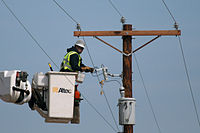
A utility electrician/lineman does maintenance on a utility pole.
Training of electricians follows an apprenticeship model, taking four or five years to progress to fully qualified journeyman level.[6] Typical apprenticeship programs consists of 80- 90% hands-on work under the supervision of journeymen and 10-20% classroom training.[7] Training and licensing of electricians is regulated by each province, however professional licenses are valid throughout Canada under Agreement on Internal Trade. An endorsement under the Red Seal Program provides additional competency assurance to industry standards.[8] In order for individuals to become a licensed electricians, they need to have 9000 hours of practical, on the job training. They also need to attend school for 4 terms and pass a provincial exam. This training enables them to become journeyman electricians. Furthermore, in British Columbia, an individual can go a step beyond that and become a "FSR", or field safety representative. This credential gives the ability to become a licensed electrical contractor and to pull permits. Notwithstanding this, some Canadian provinces only grant "permit pulling privileges" to current Master Electricians, that is, a journeyman who has been eng aged in the industry for three (3) years AND has passed the Master's examination (i.e. Alberta). The various levels of field safety representatives are A,B and C. The only difference between each class is that they are able to do increasingly higher voltage and current work.
United Kingdom
Competency standards in the UK are defined by the Sector Skills council Summit Skills. Qualifications certificated by awarding organisations such as City and Guilds and EAL are based on these National Occupational Standards. Once qualified and demonstrating the required level of competence an Electrician can register with the JIB (Joint industry Board) for an Electrotechnical Certification Scheme (ECS) card. Electrical competence is required at Level 3 to practice as an electrician in the UK. The electrical industry is one of the few that require a trade test to be achieved prior to being fully qualified. This is known as the AM2.
Electricians can demonstrate further competenc e by studying further qualifications in Design and Verification of Electrical Installations or in the Test and Inspection of Electrical Installations. These qualifications can be listed on the reverse of the JIB card.
The Electricity at Work Regulations are the statutory document that covers electrical installations. Further information is provided in the non-statutory document BS7671 - Requirements for Electrical Installations otherwise known as the Wiring Regulations currently (2013) in their 17th Edition. Installations that comply with BS7671 are deemed to have met the EAWR. Electrical Installation in domestic properties is governed by Part P of the Building Regulations and electricians have to register certain aspects of their work in domestic properties with the local building control authority.
With the exception of the work described in Part P of the Building Regulations there are no laws that prevent anyone from carrying out electrical work in the UK. A possibl e result of this is that during 2010/11 and in 2011/12 there were 3,822 domestic electrical fires in Great Britain, resulting in 14 deaths. Organisations such as the Electrical Safety Council are working hard to educate the public not to use electricians who are not fully qualified or competent and to check the ElectricSafe register to ensure an Electrician has been deemed competent.
United States
Although many electricians work for private contractors, many electricians get their start in the military.
The United States does not offer nationwide licensing and ele ctrical licenses are issued by individual states. There are variations in licensing requirements, however, all states recognize three basic skill categories: level electricians. Journeyman electricians can work unsupervised provided that they work according to a master's direction. Generally, states do not offer journeyman permits, and journeyman electricians and other apprentices can only work under permits issued to a master. Apprentices may not work without direct supervision.[9]
Before electricians can work unsupervised, they are usually required to serve an apprenticeship lasting from 3 to 5 years under the general supervision of a Master Electrician and usually the direct supervision of a Journeyman Electrician.[9] Schooling in electrical theory and electrical building codes is required to complete the apprenticeship program. Many apprenticeship programs provide a salary to the apprentice during training. A Journeyman electrician is a classification of licensing granted to those who have met the experience requirements for on the job training (usually 4000 to 6000 hours) and classroom hours (about 144 hours). Requirements include completion of two to six years of apprenticeship training, and passing a licensing exam.[10][11]
Reciprocity
An electrician's license is valid for work in the state where the license was issued. In addition, many states recognize licenses from other states, sometimes called interstate reciprocity participation, although there can be conditions imposed. For example, California reciprocates with Arizona, Nevada, and Utah on the condition that licenses are in good standing and have been held at the other state for five years.[12] Nevada reciprocates with Arizona, California, and Utah.[13] Maine reciprocates with New Hampshire and Vermont at the master level, and the state reciprocates with New Hampshire, North Dakota, Idaho, Oregon, Vermont, and Wyoming at the journeyman level.[14]
Tools
Electrici ans use a range of hand and power tools and instruments.
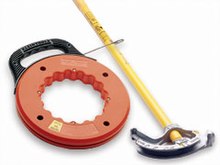
Two of the tools commonly used by electricians. The fish tape is used to pull conductors through conduits, or sometimes to pull conductors through hollow walls. The conduit bender is used to make accurate bends and offsets in electrical conduit.
Some of the more common tools are:
Conduit Bender: Bender used to bend various types of Electrical Conduit. These come in many variations including hand, electrical, and hydraulic powered.
Non-Contact Voltage Testers
Lineman's Pliers: Heavy-duty pliers for general use in cutting, bending, crimping and pulling wire.
Diago nal Pliers (also known as side cutters or Dikes): Pliers consisting of cutting blades for use on smaller gauge wires, but sometimes also used as a gripping tool for removal of nails and staples.
Needle-Nose Pliers: Pliers with a long, tapered gripping nose of various size, with or without cutters, generally smaller and for finer work (including very small tools used in electronics wiring).
Wire Strippers: Plier-like tool available in many sizes and designs featuring special blades to cut and strip wire insulation while leaving the conductor wire intact and without nicks. Some wire strippers include cable strippers among their multiple functions, for removing the outer cable jacket.
Cable Cutters: Highly leveraged pliers for cutting larger cable.
Armored Cable Cutters: Commonly referred to by the trademark 'Roto-Split' , is a tool used to cut the metal sleeve on MC (Metal Clad) cable.
Multimeter: An instrument for electrical measurement with multipl e functions. It is available as analog or digital display. Common features include: voltage, resistance, and current. Some models offer additional functions.
Unibit or Step-Bit: A metal-cutting drill bit with stepped-diameter cutting edges to enable convenient drilling holes in preset increments in stamped/rolled metal up to about 1.6mm (1/16 inch) thick. Commonly used to create custom knock-outs in a breaker panel or junction box.
Cord, Rope or Fish Tape. Used to manipulate cables and wires through cavities. The fishing tool is pushed, dropped, or shot into the installed raceway, stud-bay or joist-bay of a finished wall or in a floor or ceiling. Then the wire or cable is attached and pulled back.
Crimping Tools: Used to apply terminals or splices. These may be hand or hydraulic powered. Some hand tools have ratchets to insure proper pressure. Hydraulic units achieve cold welding, even for aluminum cable.
Insulation Resistance Tester: Commonly referred to as a Megger, these testers apply several hundred to several thousand volts to cables and equipment to determine the insulation resistance value.
Knockout Punch: For punching holes into boxes, panels, switchgear, etc. for inserting cable & pipe connectors.
GFI/GFCI Testers: Used to test the functionality of Ground-Fault Interrupting receptacles.
Voltmeter: An electrician's tool used to measure electrical potential difference between two points in an electric circuit.
Other general-use tools include screwdrivers, hammers, reciprocating saws, drywall saws, flashlights, chisels, tongue and groove pliers (Commonly referred to as 'Channellock' pliers, a famous manufacturer of this tool) and drills.
Safety
See also: Occupational safety and health
In addition to the workplace hazards generally faced by industrial workers, electricians are also particularly exposed to injury by electricity. An electrician may experience electric shock due to direct contact with energized circuit conductors or due to stray voltage caused by faults in a system. An electric arc exposes eyes and skin to hazardous amounts of heat and light. Faulty switchgear may cause an arc flash incident with a resultant blast. Electricians are trained to work safely and take many measures to minimize the danger of injury. Lockout and tagout procedures are Best Electrician Service used to make sure that circuits are proven to be de-energized before work is done. Limits of approach to energized equipment protect against arc flash exposure; specially designed flash-resistant clothing provides additional protection; grounding (earthing) clamps and chains are used on line conductors to provide a visible assurance that a conductor is de-energized. Personal protective equipment provides electrical insulation as well as protection from mechanical impact; gloves have insulating rubber liners, and work boots and hard hats are specially rated to provide protection from shock. If a system cannot be de-energized, insulated tools are used; even high-voltage transmission lines can be repaired while energized, when necessary.[15]
Electrical workers, which includes electricians, accounted for 34% of total electrocutions of construction trades workers in the United States between 1992-2003.[16]
Working conditions
Working conditions for electricians vary by specialization. Generally an electrician's work is physically demanding such as climbing ladders and lifting tools and supplies. Occasionally an electrician must work in a cramped space or on scaffolding, and may frequently be bending, squatting or kneeling, to make connections in awkward locations. Construction electricians may spend much of their days in outdoor or semi-outdoor loud and dirty work sites. Industrial electricians may be exposed to the heat, dust, and noise of an industrial plant. Power systems electricia ns may be called to work in all kinds of adverse weather to make emergency repairs.
Trade organizations
Some electricians are union members and work under their union's policies.
Australia
Electricians can choose to be represented by the Electrical Trade Union (ETU). Electrical Contractors can be represented by the National Electrical & Communications Association or Master Electricians Australia.
North America
Some electricians are union members. Some examples of electricians' unions include the International Brotherhood of Electrical Workers, Canadian Union of Public Employees, and the International Association of Machinists and Aerospace Workers.
The International Brotherhood of Electrical Workers provides its own apprenticeships through its National Joint Apprenticeship and Training Committee and the National Electrical Contractors Association. Many merit shop training and apprenticeship programs also exist, including those offered by such as trade associations as Associated Builders and Contractors and Independent Electrical Contractors. These organizations provide comprehensive training, in accordance with U.S. Department of Labor regulations.
England/Ireland
In England, electricians are represented by several unions including Unite the Union
In the Republic of Ireland there are two self-regulation/self certification bodies RECI Register of Electrical Contractors of Ireland and ECSSA.
Auto electrician
An auto electrician is a tradesman specializing in electrical wiring of motor vehicles. Auto electricians may be employed in the installation of new electrical components or the maintenance and repair of existing electrical components. Auto electricians specialize in cars and commercial vehicles.
See also
Lineman (Technician)
Gaffer (Term used in film and television)
International Brotherhood of Electrical Workers
List of electricians, notab le individuals who have worked as electricians
References
^ Roger Jones (2004). Electrician. Trotman Publishing. ISBN0-85660-997-8.
^ Shock and Awe: The Electrician Service Story of Electricity- Jim Al-Khalili
^ Tester, Ross (2008-06-05). "DIY Electrical Work: Are Aussies DUMBER than Kiwis?". Silicon Chip Online. Retrieved 2012-07-20.
^ "What Is a Journeyman Electrician?". Retrieved 2017-01-29.
^ http://www.cslb.ca.gov/applicants/Reciprocity/ReciprocityRequirements.asp CSLB CA
^ http://www.nvcontractorsboard.com/reciprocity.html State of NV
^ http://www.maine.gov/pfr/professionallicensing/professions/electricians/pdf/elecreciprocity.pdf State of ME
^ John Cadick et al, Electrical Safety Handbook Third Edition, Mc Graw Hill 2005, ISBN 0-07-145772-0
^ http://www.elcosh.org/en/document/557/d000539/why-are-so-many-construction-workers-being-electrocuted%253F.html Michael McCann, Why Are So Many Construction Workers Being Electrocuted?, retrieved 2010 July 27
External links
Wikimedia Commons has media related to Electricians.
Occupational Outlook Handbook
Retrieved from "https://en.wikipedia.org/w/index.php?title=Electrician&oldid=784490164"
If you're considering working with a landscape designer, finding the right fit -- and avoiding surprises midway through the project -- is largely about knowing which questions to ask upfront and being familiar with the range of services these professionals provide.
We reached out to four seasoned landscape professionals -- Peter Reader of Peter Reader Landscapes in London, Beth Mullins of Growsgreen Landscape Design in San Francisco, John Algozzini of K&D Landscape Management in Chicago and June Scott of June Scott Design in Southern California -- to get the inside scoop on the range of services available and the 10 essential questions potential clients should ask before hiring a professional for the job.
First, get your ducks in a row. Before reaching out to a professional, write a wish list for your garden remodel, establish your priorities and budget, and decide which parts of the process you'd like to hire a pro for help. With this on paper, you'll have a clear sens e of what you're looking for in a designer before you begin to contact professionals.
10 Questions to Ask Before Hiring a Landscape Designer
1. What services do you offer? First and foremost, determine what services a landscape designer offers to see if he or she is the right person for your project."The best question a potential client can ask is: 'Are you experienced with the scope of work we want, and can you design and manage it?'" Algozzini says.
Generally speaking, landscape designers fall into one of three categories, depending on the services they offer:
Design only. Some designers specialize only in the design process. This typically includes a site analysis and discussion of a client's needs, a preliminary design, revisions based on your feedback, and a final detailed master plan for your garden. This detailed planting plan and construction document is then handed over to you (or a landscape contractor of your choosing) to take it from there.
Design-build. Others offer the design service described above, as well as overseeing plant purchase and all installation. Contractors are needed for permitting and hardscape installation -- sometimes the landscape designer is also a registered contractor, and other times they have landscape contractors on their team or ones to recommend and oversee.
RELATED: Choose From the Best Design-Build Firms
Full service -- design-build and maintenance program. For the highest-touch service, some landscape designers will offer all the above, plus oversee ongoing maintenance of the garden.
2. Can I see examples of your past work? "Consider the style of the designer in relation to the garden you want," Reader says. "If you want a modern, clean-lined city garden, have they designed any before? Or if you are looking for a cottage-style garden, do they have the plant knowledge to deliver?"
Alternatively, if a designer's portfolio doesn't include the particular style you're looking for, check out his or her credentials for evidence of the training to make the vision of your garden a reality. Degrees from accredited landscape design colleges and memberships in professional organizations are both good indicators.
3. Do you offer garden consultations? Some landscape designers will offer one- to two-hour garden consultations. During this meeting, a designer will typically come over to your property, join you for a walk around the garden, listen to what you'd like to accomplish with your remodel and begin to bounce some i deas around for the design.
This is a great opportunity for you to determine whether you have a fit with the designer, and for the designer to see if he or she fits with you as a client. "It is important for a client to determine what role they want to play," Mullins says. "Are they interested in a collaboration, [want to] defer completely to the designer or have a clear idea for their garden and just want someone to implement it?"
Don't expect an initial consult to be free of charge -- it is, after all, two hours of a professional's time -- though some designers will put the consult fee toward the cost of the design if you end up hiring them.
4. What ideas do you have http://www.ebay.com/sch/i.html?_nkw=sprinkler for our garden? After you've shared your wish list and budget with the designer, and the designer has had a chance to view your property, ask what vision the designer has for your landscape. D esigners have different mediums of presenting their ideas for your landscape, ranging from a collage-style mood board with inspiration images for plants and hardscape materials to a two-dimensional, to-scale drawing created with a CAD program or by hand.
This is the time to speak up about what you like and dislike in the design or if you see anything that's missing from your wish list -- for example, more space for tool storage, room to grow vegetables or an area with shade. Following this meeting, a designer will draw up a revised design drawing based Sprinkler System on your feedback.
5. What is your process? A designer's process depends on the services he or she offers (see question 1). Get to know the process -- and whether you or the designer is responsible for overseeing each step -- from the beginning so that you'll know what to expect once the project is underway. If you're hiring a designer who speciali zes in design only, ask yourself whether you have the time or experience necessary to oversee the project installation or if the designer has contractors to recommend.
As a responsible client, you also need to be honest with a landscape designer regarding your budget for the project. "Knowing a budget beforehand is crucial," Mullins says. "It doesn't mean that a designer needs to spend the budget but dictates what [he or she] can realistically design for." If a look you like is over your budget, designers often have creative ways to stretch your budget and give you the best garden for your space.
6. What is the estimated cost? Clear communication regarding the estimated cost of the project and your budget is essential. Ask your designer for a range of cost for both the design and the installation. Most installation estimates are drawn up by a contractor based on the cost per square foot of installing areas of hardscape outlined on the plan for the yard.
Scott sh ares another key question to ask your designer: "How are changes in scope handled during the design and installation process?" Given that unanticipated design changes often come up midproject, it's important to be clear on whether a designer will charge additional fees for the time it takes to change the design plan or installation.
7. Are there any ways to reduce cost? Pathways, patios, retaining walls and decks are generally more expensive than planted garden areas, so the more hardscape there is in the design, the more it's likely going to cost to install. Plus, the materials used for hardscape can vary widely for both the product and the installation.
It's best to have a conversation with a designer when you are discussing the initial plan about ways to reduce the cost of the landscape to stay on budget. The designer will have ideas about where you can save money without compromising style, and what elements are worth a splurge.
8. How long will installation take? The time it takes to design and install a landscape depends on a number of factors: size and scope of the project, availability of contractors and other installation specialists, ordering and delivery times for materials and plants, dry weather for laying hardscape, and unexpected setbacks during installation. Instead of asking a landscape designer to have the installation done by a certain date, ask for an estimated range for the project to be completed.
As eager as you may be to enjoy your new landscape, keep in mind that skilled installation of hardscape and careful planting takes time. "While landscaping on TV is inspirational and great entertainment, the actual site work rarely has a team of 24 [people] working around the clock," Algozzini says. "High-quality work is both art and science, and takes time to install."
RELATED: How to Work With a Landscape Professional
9. When will the garden grow in? The time it takes for a garden to grow in depends on the scope of the design, what types of plants are proposed and how mature the plants are when they're planted. A smaller area with ornamental grasses and perennials can grow in within a single season, but larger and more complex designs with trees and large shrubs can take years to reach maturity. Ask your designer which plants make sense to splurge for semimature specimens (like focal-point trees or shrubs needed for screening) and which plants can be purchased small and fill in quickly (like most ground covers, vegetables and ornamental grasses).
10. How much maintenance will it take to keep the garden looking good? Different styles of gardens and plants require very different levels of care. Be upfront with your landscape designer about how much maintenance you are willing to commit -- either your own time or that of a hired gardener -- going forward. Once you've invested in hiring a landscape designer and install ing a garden, you'll want to keep your landscape alive and flourishing for years to come. Ask your landscape designer if he or she has recommended maintenance gardeners or specialists to take care of the garden going forward.


 The hardware mounts in your home, the software is accessible online.